
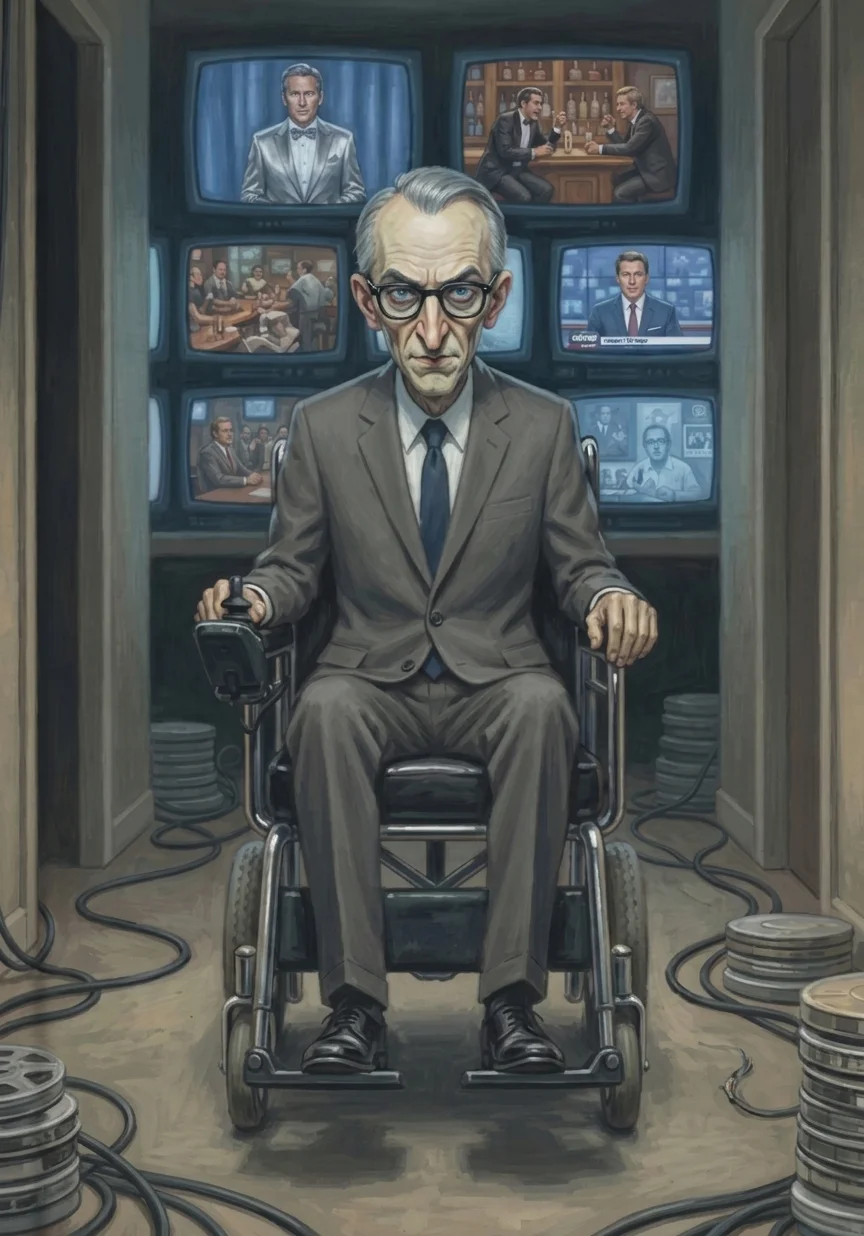
Static and Sophistry at Channel 101
Inspired by "SCTV" TV series
An illustrated English short story for advanced learners (C1–C2), read aloud by a narrator, with a quiz at the end. Read and listen to the opening below.
The opening
Deep within the concrete labyrinth of Turnipton, Channel 101 hummed with the electric scent of ozone and impending litigation. At the helm sat Fitzgerald, a man who viewed the world through a lens of magnificent, budget-constrained grandiosity. From his motorized wheelchair, a throne of chrome and vinyl, he commanded the airwaves. To Fitzgerald, a deficit was merely a lack of creative audacity, and a union strike was nothing more than a quiet day at the office. He maneuvered through the cramped hallways, his eyes gleaming with the predatory light of a man about to greenlight a masterpiece for the price of a ham sandwich.
The story continues in LexiBox.
Check yourself
Three questions from the quiz at the end of the book.
-
According to the text, what is Fitzgerald's solution when Fenella points out their lack of resources for the Roman epic?
Show the answer
D: To re-imagine the epic as a minimalist, avant-garde piece.
-
What can be inferred about the actual content of "The Suds Shed"?
Show the answer
D: The show rarely discusses its official topic of ice fishing.
-
In the sentence, "The technical failures began as a trickle and quickly became a deluge," what does the word "deluge" mean?
Show the answer
C: An overwhelming flood or quantity.
Read the whole book in LexiBox
Static and Sophistry at Channel 101 is one of the Premium books: the whole story with its pictures, narrated from start to finish, with a translation into your own language when you need one, and the full quiz. A free account starts you with the free books at every level.
No credit card to start.
More advanced stories
-
 The Audacity of the Unbooked1,010 words · 8 min
-
 Lumberport on Lake Aspire858 words · 6 min
-
 The Architecture of the Absurd865 words · 6 min
-
 The Matrimonial Meltdown826 words · 6 min
-
 The Mockumentary Misadventure809 words · 6 min
-
 The Outback Bureaucracy902 words · 7 min
Free to read at C1–C2
-
 The Great Groom Hunt647 words · 5 min · Free
-
 The Light of Dawnbrand606 words · 4 min · Free
-
 The Azure Key624 words · 4 min · Free
-
 The Tear of the Brave686 words · 4 min · Free
-
 Neris and the Endless Blue655 words · 4 min · Free
-
 The Weaver of Starlight880 words · 7 min · Free
Easy stories (A1–A2)Intermediate stories (B1–B2)All storiesEnglish grammarLearn English